

Skip to content
Skip to content
  • LinkedIn
Louise Cousins Louise Cousins Louise Cousins

Digital Leader. Creator. Writer. Explorer.

Louise Cousins Louise Cousins Louise Cousins

Digital Leader. Creator. Writer. Explorer.

  • Home
  • Articles
    • Adversity
    • Artificial Intelligence (AI)
    • Creativity
    • Customer Experience (CX)
    • Live Work Balance
    • Machine Learning (ML)
    • Metaverse
    • Pandemic
    • Public Speaking
    • Resilience
    • Technical SEO
    • Time Management
    • User Experience (UX)
    • Digital
    • Women in Tech
  • Published Work
  • About Me
  • The Project
  • Home
  • Articles
    • Adversity
    • Artificial Intelligence (AI)
    • Creativity
    • Customer Experience (CX)
    • Live Work Balance
    • Machine Learning (ML)
    • Metaverse
    • Pandemic
    • Public Speaking
    • Resilience
    • Technical SEO
    • Time Management
    • User Experience (UX)
    • Digital
    • Women in Tech
  • Published Work
  • About Me
  • The Project
Louise Cousins Louise Cousins Louise Cousins

Digital Leader. Creator. Writer. Explorer.

Louise Cousins Louise Cousins Louise Cousins

Digital Leader. Creator. Writer. Explorer.

  • Home
  • Articles
    • Adversity
    • Artificial Intelligence (AI)
    • Creativity
    • Customer Experience (CX)
    • Live Work Balance
    • Machine Learning (ML)
    • Metaverse
    • Pandemic
    • Public Speaking
    • Resilience
    • Technical SEO
    • Time Management
    • User Experience (UX)
    • Digital
    • Women in Tech
  • Published Work
  • About Me
  • The Project
  • Home
  • Articles
    • Adversity
    • Artificial Intelligence (AI)
    • Creativity
    • Customer Experience (CX)
    • Live Work Balance
    • Machine Learning (ML)
    • Metaverse
    • Pandemic
    • Public Speaking
    • Resilience
    • Technical SEO
    • Time Management
    • User Experience (UX)
    • Digital
    • Women in Tech
  • Published Work
  • About Me
  • The Project
Articles
July 8, 2026
TPD003 The Difference Between Research and Knowledge Engineering
July 6, 2026
TPD002 The day I realised my onboarding strategy had reached its limits.
July 5, 2026
TPD001 The AI I Had to Fire
June 9, 2026
What Neurodiversity Taught Me About User Experience
Home/Artificial Intelligence (AI)/TPD003 The Difference Between Research and Knowledge Engineering
Artificial Intelligence (AI)

TPD003 The Difference Between Research and Knowledge Engineering

By LCousins
July 8, 2026 4 Min Read
0

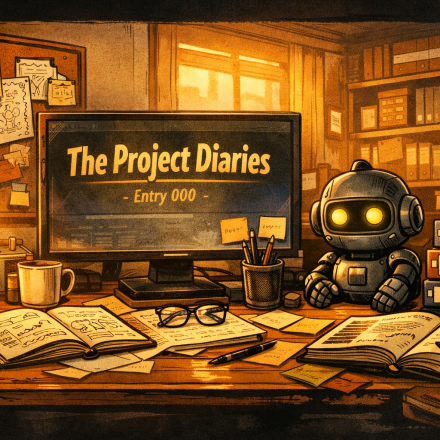
The Project Diaries – Entry 003

Somewhere during this project, I realised I’d quietly stopped researching things. That sounds strange because I was reading more than ever. Papers, standards, documentation, blog posts, technical discussions. The flow of information kept increasing, yet it didn’t feel as though I was becoming proportionally more knowledgeable. That made me question whether I had been measuring the wrong thing all along.

For a long time, I assumed learning was about research. Find the information. Read widely. Organise your notes. Build a picture. Eventually you’ll know enough to make good decisions. It felt entirely reasonable. The more information we collect, the better informed we become. Except that isn’t quite what I experienced.

Gradually, I found myself thinking less about information and far more about knowledge. At first, I treated those words as though they meant the same thing. Slowly, I realised they didn’t. That distinction quietly changed the way I approached almost everything.

Access to information is becoming abundant. Search engines can find almost anything. AI can summarise thousands of pages in seconds. Entire libraries sit a few keystrokes away. Finding information has become remarkably easy. Understanding it hasn’t. We have access to more material than any previous generation, yet many of us still struggle to answer simple questions with confidence. I don’t think that’s because we’re reading less. I think it’s because information and understanding are not the same thing.

I stopped trying to build a collection of information. I started trying to understand the relationships between ideas. The biggest breakthroughs almost never came from finding another document. They came from unexpected connections. A design decision from months earlier would suddenly clarify something I’d read that morning. A conversation about software architecture would illuminate a completely different problem. Two authors, writing in different fields, would turn out to be describing similar ideas using different language. None of the information had changed. Only the relationships between it.

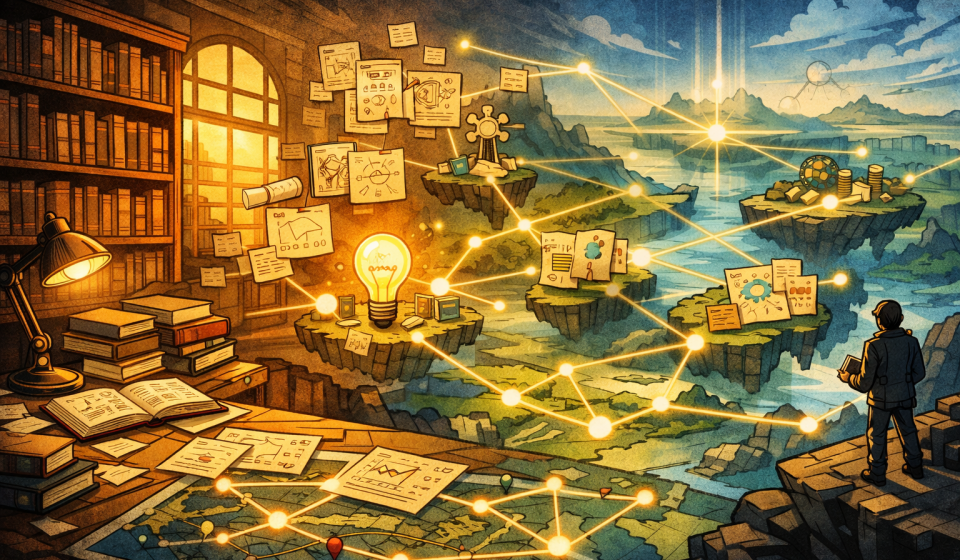
Imagine walking into a library. Every shelf is filled with excellent books. Every author is knowledgeable. Every book has been carefully researched. You’ve gained access to an extraordinary amount of information. But the books don’t speak to one another. There are no relationships, no context, no shared understanding. You leave carrying a backpack full of facts, but perhaps not much knowledge.

Now imagine something different. Instead of organising the books alphabetically, you begin drawing lines between ideas. This concept supports that one. These two appear unrelated until viewed from a different angle. Several authors describe the same underlying principle using different language. One observation quietly explains three others. Suddenly, something interesting happens. The individual books become less important than the relationships between them. The map becomes more valuable than the library.

The more I thought about this, the more I realised that curiosity often begins with questions, but knowledge grows through relationships. It isn’t something we simply gather. It’s something we build. Not by inventing new facts, but by organising them, testing them, connecting them, refining them, and allowing them to evolve as new understanding emerges. It’s slower than searching for answers, but far more rewarding.

Working alongside AI contributors made this distinction impossible to ignore. Models can retrieve astonishing amounts of information in seconds. They can explain papers I’ve only just started reading and summarise documentation faster than I can finish making a cup of tea. None of that guarantees understanding. If the surrounding knowledge has weak structure, faster retrieval may simply produce faster summaries of fragmented information. The more I experimented, the less interested I became in retrieval itself. Instead, I found myself asking a different question: how should knowledge be organised so that good answers become possible? The quality of an answer depends not only on what information exists, but on how that information relates to everything around it.

Perhaps my favourite thing about knowledge is that it never really reaches a finish line. Research often does. You complete the report, publish the paper, answer the question, move on. Knowledge feels different. Every new idea changes the shape of everything around it. Connections strengthen. Assumptions shift. Unexpected relationships appear. Understanding deepens. The work isn’t about collecting more information. It’s about continually improving the map. I rather like that idea.

I’ve stopped believing that knowledge is measured by how much information we possess. Increasingly, I think it’s measured by how well we understand the relationships between ideas. Information tells us what exists. Knowledge helps us understand why it matters. Perhaps that’s the difference between research and knowledge engineering. One discovers information. The other quietly transforms information into understanding. I’m no longer convinced the hardest part of engineering knowledge is finding information. Increasingly, I think the harder problem is helping ideas discover one another. Research fills the library. Knowledge engineering draws the map. And in a world where information is becoming almost limitless, the map may turn out to be the more valuable thing to build.

There are projects that teach you new technical skills. Then there are projects that quietly change the way you think. I’ve come to realise those are rarely the same thing.

Tags:

AI EngineeringContinuous LearningEngineering JudgementInformation ArchitectureKnowledge EngineeringKnowledge ManagementSoftware EngineeringSystems ThinkingTechnical LeadershipThe Project Diaries
Author

LCousins

Louise Cousins is a Digital Leader, UX Strategist, and Creative Technologist with more than 20 years of experience leading global digital transformation, accessibility, governance, user experience, analytics, and technology initiatives. Her writing explores the intersection of leadership, technology, human-centred design, accessibility, creativity, and the evolving relationship between people and digital experiences.

Follow Me
Other Articles
Previous

TPD002 The day I realised my onboarding strategy had reached its limits.

No Comment! Be the first one.

    Leave a Reply Cancel reply

    Your email address will not be published. Required fields are marked *

    Latest Posts

    • TPD003 The Difference Between Research and Knowledge Engineering
      by LCousins
      July 8, 2026
    • TPD002 The day I realised my onboarding strategy had reached its limits.
      by LCousins
      July 6, 2026
    • TPD001 The AI I Had to Fire
      by LCousins
      July 5, 2026
    • What Neurodiversity Taught Me About User Experience
      by LCousins
      June 9, 2026
    • Website Best Practices for 2026: Designing for Humans, AI, and an Increasingly Complex Digital World
      by LCousins
      March 7, 2026
    • TPD000 The Beginning: Why I Started Learning AI the Long Way Round
      by LCousins
      February 22, 2026
    • When Less Website Traffic Doesn’t Always Spell Less Impact
      by LCousins
      November 21, 2025
    • Honouring the Past, Embracing the Present
      by LCousins
      November 6, 2025
    • Misogyny and Sexual Harassment in the Workplace: The Harm of Covert Comments and Why Laughing It Off Is Not Consent
      by LCousins
      November 5, 2025
    • Empowering Women in Technology: A Call for Equity, Not Dominance – Part 1
      by LCousins
      September 12, 2025
    • How Large Language Models Are Redefining the Future of SEO
      by LCousins
      September 4, 2025
    • The European Accessibility Act and Why Accessibility Matters Beyond Compliance
      by LCousins
      July 31, 2025
    • Website Best Practices for 2025
      by LCousins
      June 2, 2025
    • Adventures in Dating: A Single Mum’s Journey Through Love in Her 40s
      by LCousins
      May 19, 2025
    • Building Resilience: Living a Life in the Sunlight
      by LCousins
      May 11, 2025

    Artcles you may have missed

    Artificial Intelligence (AI)

    TPD003 The Difference Between Research and Knowledge Engineering

    LCousins
    By LCousins
    July 8, 2026
    Artificial Intelligence (AI)

    TPD002 The day I realised my onboarding strategy had reached its limits.

    LCousins
    By LCousins
    July 6, 2026
    Artificial Intelligence (AI)

    TPD001 The AI I Had to Fire

    LCousins
    By LCousins
    July 5, 2026
    Accessibility Customer Experience (CX) Random Life Musings User Experience (UX)

    What Neurodiversity Taught Me About User Experience

    LCousins
    By LCousins
    June 9, 2026
    A woman browsing digital designs on a laptop while sitting comfortably at home.
    Digital

    Website Best Practices for 2026: Designing for Humans, AI, and an Increasingly Complex Digital World

    LCousins
    By LCousins
    March 7, 2026
    Artificial Intelligence (AI)

    TPD000 The Beginning: Why I Started Learning AI the Long Way Round

    LCousins
    By LCousins
    February 22, 2026
    Artificial Intelligence (AI) SEO

    When Less Website Traffic Doesn’t Always Spell Less Impact

    LCousins
    By LCousins
    November 21, 2025
    Adversity Random Life Musings Resilience

    Honouring the Past, Embracing the Present

    LCousins
    By LCousins
    November 6, 2025
    A woman holding a help sign, depicting workplace harassment in an office setting.
    Adversity Women in Tech

    Misogyny and Sexual Harassment in the Workplace: The Harm of Covert Comments and Why Laughing It Off Is Not Consent

    LCousins
    By LCousins
    November 5, 2025
    • Terms & Conditions
    • Accessibility
    Copyright 2026 Louise Cousins. Louise Cousins, All rights reserved